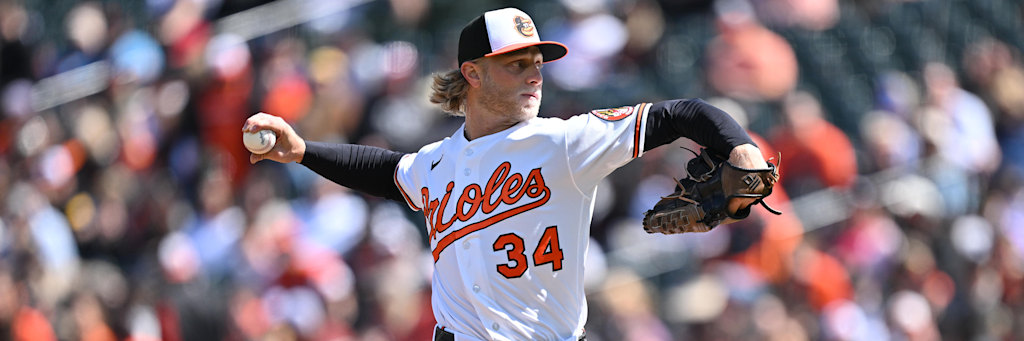
Strip a starting pitcher's season ERA away and read only the slope of his last five lines, and you will sometimes find a different pitcher than the box-score average describes. That is the entire premise behind tonight's projection. Shane Baz carries a 4.29 ERA on the season, a perfectly ordinary number, but the trajectory underneath it is not ordinary at all, and a model that weights recent form over season aggregate sees a Toronto run column that lands beneath the posted line. The play is the Blue Jays team total under 4.5 at -135 for half a unit, and the case is built almost entirely on the second derivative of Baz's recent work.
Verified Game Setup And Pitching Matchup
| Team | Probable starter | 2026 record |
|---|---|---|
| Orioles | Shane Baz (RHP, 4.29 ERA) | 31-34 |
| Blue Jays | Kevin Gausman (RHP) | 31-34 |
First pitch is at Rogers Centre in Toronto. Baltimore sends Shane Baz, Toronto counters with Kevin Gausman, and the single variable this ticket prices is the Toronto run column. Gausman and the Blue Jays' run-prevention side belong to a separate market. Two clubs sitting at an identical 31-34 makes this a clean offense-versus-arm question with no record imbalance to lean on.
The Baseline: A 4.07 Run Per Game Offense Priced At 4.5
Begin with the season-weighted anchor. Over its last 30 games Toronto has scored 122 runs, a rate of 4.07 runs per game, and across that same 30-game window the Blue Jays were held to three runs or fewer in 15 of them, exactly half. A line of 4.5 therefore asks this offense to outscore its own monthly rate by 0.43 of a run, against a starter who is throwing the ball better than his ERA. The recent ten-game shape is unusually flat and supportive: Toronto's run column reads 2, 2, 6, 5, 5, 3, 3, 7, 3, 6, a distribution with no shutouts but a heavy clustering in the two-to-three-run band. Six of those ten games finished at or below four runs. This is not a boom-or-bust offense the model is trying to fade through variance. It is a steady, middle-of-the-pack run engine sitting right at the line, which is the cleanest profile a team-total under can ask for.
The Baz Form Curve Is The Engine
Here is the hyper-specific case, start by start. Across Shane Baz's last five outings his game-by-game earned-run line reads 5, 3, 1, 1, and 2. That is four consecutive starts of two earned runs or fewer after the May 9 clunker against the Athletics, and the underlying work has improved alongside the results. On May 26 he went 7 innings, allowed 1 earned run, and struck out 9. On June 2 he went 7 innings against Boston and allowed 2 earned runs with 6 strikeouts. The two seven-strikeout-caliber starts back to back, paired with the length, are the data points the model leans on. A pitcher generating that strikeout volume while working deep is removing balls in play from the Toronto offense's reach, and a strikeout is the most park-neutral out in the sport, which matters at a venue like Rogers Centre that can otherwise reward contact.
The ERA lag is the inefficiency. The market and the recreational bettor anchor to 4.29, the season number, while the last-month sample says Baz has been a sub-3.00 arm. The model does not throw the season away, but it weights the four-start run of two earned or fewer heavily, and that weighting is what drags the Toronto projection beneath the 4.5 line.
Three Verified Signals That Converge
The conviction comes from independent inputs pointing the same way. First, Toronto's 4.07 runs per game over 30 games sits below the 4.5 line before any matchup adjustment. Second, Baz's last four starts of 1, 1, 2, and the rebound trajectory show an arm in its best form of the year, not the 4.29 the market is pricing. Third, the recent Toronto distribution, with six of ten games at four runs or fewer and a tight two-to-three-run mode, is the low-variance shape that makes an under projectable rather than a coin flip. When the offense's central tendency, the opposing arm's form curve, and the recent run distribution all agree, the projection earns a spot on the card.
Where The Model Lands
The projection puts the Toronto run column beneath the 4.5 line, and the gap is modest rather than dramatic, which is why this is a half-unit play and not a flagship stake. The edge is the difference between Baz's lagging ERA and his actual recent output, plus an offense already sitting below the line on its monthly rate. That is a real and measurable inefficiency, but it is not a chasm, and an honest model sizes to the size of the gap. A 4.07 offense facing an arm in genuine form does not require a heroic stake to be the correct side. It requires the right side and the right size.
How To Read The Price
At -135 the break-even probability is 57.4 percent. The model's read of the Toronto run column landing below 4.5, given a 4.07 monthly rate and a starter on a four-start run of two earned runs or fewer, clears that threshold with enough margin to qualify for the card but not enough to warrant a large stake. The specific market inefficiency is the ERA anchor: books and public bettors price Baz off his 4.29 season line, while his last five starts describe a pitcher performing well under 3.00. That lag between perception and recent reality is the gap the under is buying.
The Filter That Kept This On The Card
One process note, in the spirit of showing the work. The current model was rebuilt off a deep backtesting overhaul, and one promoted rule excludes the hottest offenses from the under pool entirely, because a top-quintile rolling-month bat is the single most likely profile to blow through a low team total. Toronto at 4.07 runs per game over 30 games is comfortably outside that exclusion zone, which is why the Blue Jays survive the filter while hotter lineups do not. Stakes scale with the depth of the projected gap, and a modest edge against a steady offense earns the half-unit it is sized at, no more.
The Honest Counterpoint
The risks are concrete and worth stating without spin. Baz's form curve is exactly that, a curve, and a single start can break it, as his 5-earned-run May 9 against the Athletics proves the floor is live. Toronto put up 7 and 6 within the last ten games, so the bats are not dormant, and a 4.5 is a number a single three-run inning at Rogers Centre can erase before the bullpens get involved. The Toronto lineup was not confirmed at publication, so the projection assumes the regulars. A team total this close to an offense's own rate is, by definition, a thin edge, which is precisely why the stake is half a unit rather than a conviction number.
What Beats It
A crooked early inning beats this ticket. If Baz reverts to the version that gave up five earned to the Athletics, Toronto's steady offense clears 4.5 without needing to be great. The Blue Jays' 7 and 6 in the last ten show the ceiling is real, and a Rogers Centre environment can turn solid contact into damage. The play leans on Baz holding the form of his last four starts and Toronto staying the 4.07-run offense its month describes.
Final Verdict
The official play is the Blue Jays team total under 4.5 at -135 for 0.5 units at Rogers Centre. The edge is a 4.07-runs-per-game Toronto offense priced at 4.5, a Shane Baz form curve of 1, 1, and 2 earned runs in his last three starts with back-to-back outings of 9 and 6 strikeouts, and a recent run distribution that puts six of the last ten Blue Jays games at four runs or fewer. The market is pricing Baz's season ERA. The model is pricing the pitcher his last month actually describes. For more from the card, see the prediction archive, the latest model plays, and the homepage board.
Pick and odds come from the BetLegend daily tracker. Probable starters, records, season run rates, recent run totals, and starter game logs were verified against MLB Stats API data for June 7, 2026.