Last Saturday in Anaheim, Jacob deGrom struck out nine Angels in five innings and allowed one run. Five days later he gets the same lineup in the same building, and the card is paying -140 for the second showing. Two plays tonight, two units total, and they want opposite things: three runs or fewer from one lineup in Anaheim, nine or more combined from two others in Minneapolis.
That is a deliberately small night. Monday's eight-play, twelve-unit card went 3-5 for a net of -1.11 units, Tuesday saw no plays at all, and a nine-game Thursday board produced exactly two prices worth paying. When the card shrinks after a losing night, that is discipline rather than caution, and both of tonight's tickets carry arguments you can count.
THE QUIETEST HOME OFFENSE ON THE BOARD
Start with the base rate, because it does most of the work. The Angels have been held to three runs or fewer in 35 of their 61 home games this season, 57.4 percent of the time, against any pitching at all. A -140 ticket needs 58.3 percent to break even. The entire bet reduces to one question: does Jacob deGrom starting move a coin that already lands on this side 57 percent of the time by at least one more percentage point?
The home-road split says the 57 percent is real and not noise. Los Angeles hits .223/.299/.336 at Angel Stadium, a .635 OPS, with 46 home runs in 61 games there against 78 in 60 games on the road. They have scored 218 runs at home all season, 3.57 per game. This is a 47-74 club, tied with the Athletics for the worst record in baseball, and the half of its schedule played in Anaheim is where the offense goes to disappear. Seven of their last ten games produced three runs or fewer.
Then there is the arm. deGrom carries a 3.87 ERA with a 1.13 WHIP, 144 strikeouts against 30 walks in 118.2 innings, a .229 opponent average and 10.92 strikeouts per nine. The strikeout matters more here than anywhere else on the slate, because a lineup slugging .336 at home needs balls in play and baserunner traffic to scratch out runs, and deGrom concedes neither. His August 8 start against this exact team was the proof of concept: five innings, three hits, one earned run, nine strikeouts.
Walbert Ureña matters to the game and not at all to the ticket. His 2.83 ERA and .205 opponent average are legitimate, his 4.87 walks per nine are the crack in them, and none of it touches a bet that only counts Angels runs. Texas could score twice or twelve times tonight and this play would not notice.
WHAT THE -140 IS ACTUALLY BUYING
Here is the honest version of the risk. deGrom has not pitched into the sixth inning in any of his last five starts. The stretch reads 5.0, 4.2, 5.0, 3.1 and 5.0 innings, and the short one, 3.1 innings with five earned and five walks in Seattle on August 1, is the shape of the outing that beats this ticket. When he leaves after five, the last four innings of Angels at-bats belong to a Texas bullpen that has converted 34 saves against 16 blown, a solid group, but relievers are variance and a team total under wants innings from the starter.
The counterweight is that this lineup does not punish middle relief either. A .635 home OPS is a season-long fact across every reliever the Angels have seen in that building. The bet is not that deGrom throws a gem. The bet is that a 57.4 percent base rate holds with an above-average strikeout arm on the mound instead of an average one, and at 58.3 percent required, the margin being purchased is razor thin and real.
NOLA'S HOME RUN RATE GOES TO IOWA
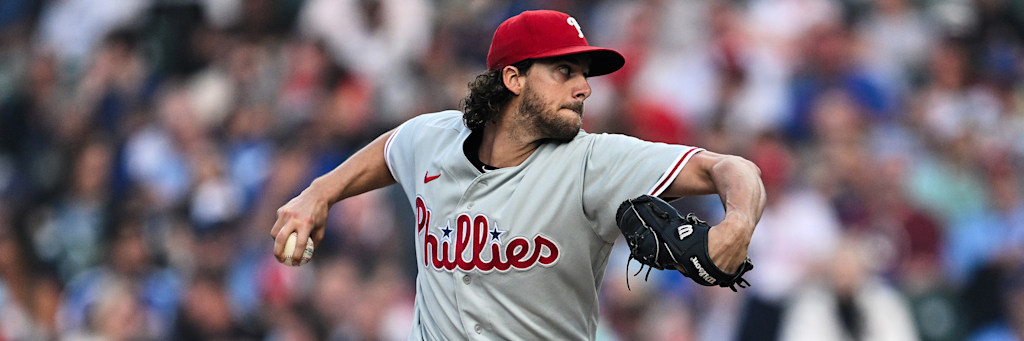
First, the venue, because it is the strangest thing on the board tonight. This game is not in Minneapolis. Philadelphia and Minnesota meet at the Field of Dreams in Dyersville, Iowa, MLB's one-night special-event park, with the Twins as the designated home team. A one-off venue has no 2026 sample, no season-long run environment, nothing to lean on. Every argument for this total has to come from the lineups and the arms, which suits this particular total fine, because the arms are the whole case.
Aaron Nola is having the loudest bad season of any veteran starter in the league, and this ticket is a direct bet on the noise continuing. He is 3-9 with a 5.47 ERA and a 1.45 WHIP, opponents are hitting .279 against him, and the headline number is 29 home runs allowed in 125 innings, a rate of 2.09 per nine. He has allowed at least one home run in each of his last five starts, nine total across that stretch. The strikeouts are still there at 9.29 per nine, which keeps him in games, but the contact he allows leaves the yard at a rate that turns quiet innings loud in one swing.
Taj Bradley is the quieter half of the argument and the more interesting one. His 3.76 ERA and .220 opponent average look like an over-killer until you read the last three weeks: eight earned runs across his last three starts and 17 innings, with walks at 3.76 per nine feeding traffic ahead of mistakes. The offense behind him is real wherever it plays: Minnesota has scored 4.57 runs per game as the home side this season with a .726 OPS in that role, and its last ten games cleared 8.5 combined runs five times, with scores of 13, 10, 14, 14 and 12 in the five that did.
At -115 the ticket needs 53.5 percent, and with no venue history to price, the recent form carries the argument: Philadelphia's last ten games have cleared 8.5 combined runs seven times, Minnesota's have cleared it five, and the two staffs involved carry ERAs of 4.20 and 4.60. Half a unit is the correct size for a bet that leans entirely on its pitchers in a park nobody has a book on, and Nola has been supplying the runs all summer.
WHAT BEATS THIS CARD
Philadelphia's road offense beats the over. The Phillies hit .223/.291/.360 away from home, a .651 OPS, and score 3.92 runs per game on the road, where their games have averaged 8.08 combined runs and cleared 8.5 only 23 times in 60. If Nola keeps the ball in the park for once and Bradley's first five innings look like July's, this lands 7-5 short of the number in a hurry.
A short deGrom start beats the under. So does the version of this Angels lineup that showed up on August 12 and scored five, or the one that hit 78 road home runs, if it decides the road power travels home for a night. A 58.3 percent break-even against a 57.4 percent base rate leaves no room for a bad bullpen inning, and that closeness is exactly why the play is 1.5 units and not three.
The rest of the board was left alone on purpose. Brewers and Dodgers, the two best records in the National League at 74-47 and 73-48, meet at Dodger Stadium with Roki Sasaki going, and there was no price worth paying on either side. Nine games, two plays, and everything else is a watch.
CARD SUMMARY
| Play | Line | Units | Break-Even | Key Number |
|---|---|---|---|---|
| Los Angeles Angels Team Total Under 3.5 | -140 | 1.5 | 58.3% | LAA held to 3 or fewer in 35 of 61 home games; .635 home OPS |
| Phillies/Twins Over 8.5 (Field of Dreams, Dyersville) | -115 | 0.5 | 53.5% | Nola 29 HR in 125 IP; staff ERAs of 4.20 and 4.60 |
Two units, two arguments, one shared principle: bet the number the season has already been writing. The Angels' home offense has spent 61 games proving it belongs under 3.5, and tonight it faces the wrong arm to start proving otherwise. Nola has spent 125 innings proving his mistakes leave the park, and tonight he brings that habit to a one-night ballpark in Iowa where the pitchers, not any venue history, will decide the number. Neither price is a gift. Both are prices the evidence covers.
The August 11 Sharp Money Card The August 10 Sharp Money Card 2025-2026 Track Record Bankroll Management Guide 2026 Futures Board Full Archive