Houston and the Athletics have played seven times this season. The tightest of those seven finished 12 to 10. The other six went by four, seven, eleven, four, five and eleven runs, including a 4 to 0 Astros win on Friday night at Daikin Park. Not one of them landed inside a single run. That fact is the load bearing wall under the largest stake on tonight's card, because the Astros are laying an alternate run line of -1 at -180 for two units, and a Houston win by exactly one run does not cash that ticket. It gives the money back.
Most cards get written up leg by leg. This one is better understood by where the weight sits. Four tickets, 5.5 units, and 2 of those units are parked on a number that does not appear on the main betting board at all.
THE CARD
Every price above is the price taken. Nothing here is rounded, shaded or presented at a better number than the one on the ticket.
WHAT THE ALTERNATE -1 ACTUALLY BUYS
Houston is -240 on the moneyline against the Athletics. The standard run line reads -1.5 at -105. Sitting between them is the alternate at -1, priced -180. Those three numbers describe three different bets on the same team.
At -240 the Astros only have to win. At -1.5 they have to win by two, and a one run victory is a losing ticket. At -1 they still have to win by two, but a one run victory returns the stake instead of taking it. That middle option costs 60 cents against the moneyline and buys back the single most common losing margin a favorite backer runs into.
| Ticket | Price | Break even | Wins when | One run Houston win |
|---|---|---|---|---|
| Astros moneyline | -240 | 70.59 percent | Houston wins | Cashes |
| Astros -1 alternate | -180 | 64.29 percent | Houston by 2 or more | Pushes |
| Astros -1.5 run line | -105 | 51.22 percent | Houston by 2 or more | Loses |
Here is the part that makes the choice defensible rather than lazy. Houston has 65 wins this season. Fifty two of them came by two runs or more and only 13 came by exactly one. Across all 129 Astros games, 24 have been decided by a single run, a rate of 18.6 percent that is the lowest of the eight clubs involved in tonight's four games. This is not a team that scrapes.
Set that against the league. Across 1,935 completed regular season games this year, 527 finished by exactly one run, or 27.24 percent. Houston sits nine full points below that baseline. The alternate line is being bought at a discount to the general shape of baseball, because this particular club keeps producing separation.
THE PRICES ARE BETTER THAN THE SCREEN
Two of the four legs were taken through a number that beats the widely posted price, and on a card this size that is worth more than a paragraph of matchup talk.
| Leg | Card price | Break even | Widely posted | Break even there |
|---|---|---|---|---|
| Rays moneyline | -126 | 55.75 percent | -132 | 56.90 percent |
| Guardians moneyline | -137 | 57.81 percent | -145 | 59.18 percent |
A point and a third of break even on the Guardians leg and just over a point on the Rays leg. Neither one wins a game by itself. Over a season of tickets, that difference is the entire margin most handicappers are playing for.
THE RAYS ARE THE BEST TEAM ON THE BOARD AND THEY KEEP LOSING TO THIS OPPONENT
Tampa Bay is 76-52 and has allowed 539 runs, the second lowest figure among the eight teams playing in these four games behind Detroit's 500. Baltimore is 62-67 with 613 runs allowed. Shane McClanahan takes the ball at 9-6 with a 3.25 earned run average, a 1.12 WHIP and eight home runs surrendered across 102.1 innings. Brandon Young answers at 3.52 with a 1.35 WHIP and 15 home runs in 117.2 innings.
McClanahan's home run suppression is the cleanest separator in the game. Eight in 102.1 innings works out to 0.70 per nine. Young sits at 1.15.
The problem is that Baltimore has been winning these anyway. The Orioles took three of four at Tampa Bay from August 14 through August 17, by scores of 6 to 5, 4 to 3 and 10 to 2, dropping only a 7 to 6 game. They then beat the Rays 5 to 3 on Friday. Baltimore has won five of the last six meetings and holds a 6-5 edge in the season series. Tampa Bay carries a two game losing streak into tonight and Baltimore arrives on a one game winning streak.
The ticket goes in anyway, at one unit, because 55.75 percent is a modest ask for a club 24 games above the break even line of its own record against a club five games below it. That is not a strong ask. It is a fair one.
THE 1.5 UNIT LEG IS THE ONE WORTH ARGUING ABOUT
Detroit team total under 4.5 at -139 requires 58.16 percent. Detroit has scored four runs or fewer in 72 of its 128 games this season. That is 56.2 percent. The season base rate is two full points short of the price.
So the case cannot rest on Detroit being a weak offense in general, because at 4.52 runs per game the Tigers are close to average. It has to rest on tonight.
Michael Wacha is 6-8 with a 3.58 earned run average across 25 starts and 155.2 innings, the heaviest workload of any starter on this card. His 1.15 WHIP trails only Shane McClanahan's 1.12 on the board. He walks 2.37 hitters per nine, the lowest rate of the eight probables, and that matters enormously for a team total, because free bases are how a modest offense manufactures its fourth and fifth runs.
Then there is the head to head file, and it is emphatic. Detroit and Kansas City have played 11 times this season. Detroit scored four runs or fewer in nine of those 11 games, with a line of 2, 2, 10, 3, 1, 6, 4, 2, 2, 4 and 2. Twice the Tigers cleared this number against this pitching staff. On Friday night in Kansas City they managed two in a 5 to 2 loss.
Kansas City is also playing its best baseball of the year, riding a six game winning streak at 56-74.
CLEVELAND AT ALTITUDE, WHICH IS ALWAYS AN ARGUMENT
Gabriel Hughes is 0-4 with a 6.69 earned run average and a 1.38 WHIP across seven starts. Tanner Bibee brings a 4.01 earned run average and a 1.15 WHIP over 26 starts and 150.1 innings. His 4-13 record is one of the more misleading lines in the sport this season, and it comes from a Cleveland offense that has scored 516 runs, fewest of the eight teams in play tonight.
Bibee has also allowed 25 home runs in 150.1 innings, 1.50 per nine, a rate beaten on this card only by the Athletics' Jacob Lopez at 1.53. Taking that profile to Coors Field is the kind of decision that gets a handicapper in trouble, and the posted game total of 11 says the market agrees.
The counterweight is that Colorado is 50-78, has lost four straight, and has allowed 742 runs. Cleveland opened this series on Friday by winning 9 to 1 in that same ballpark. One unit at -137 on the better club is a normal bet, and the ATLAS model projection of 5.53 Cleveland runs at altitude supports the side rather than the price.
THE CASE AGAINST THIS CARD
Weighted by stake, these four tickets have to hit 59.89 percent to break even. That is a demanding number, and it is demanding because of the -180 leg specifically. Two of the 5.5 units sit at a 64.29 percent break even, which pulls the whole card upward.
Start the objection there. Houston is 65-64. The Athletics are 49-80 and have lost five in a row. Yet the season series between them stands at 4-3 in favor of the Athletics, who won two of three in Oakland in April by scores of 11 to 4 and 12 to 10, then took the finale of the June set in Houston 5 to 0. Laying -180 into a team that has beaten you four times in seven tries is a real thing to sit with.
The Houston offense is also quiet at the moment. Across the Astros' last ten games they have put up 6, 1, 2, 10, 5, 2, 1, 3, 3 and 4 runs. That is 37 runs in ten games, and six of those ten produced three runs or fewer. A team laying a two run margin has to score, and the recent shape of this lineup does not look like a club that separates.
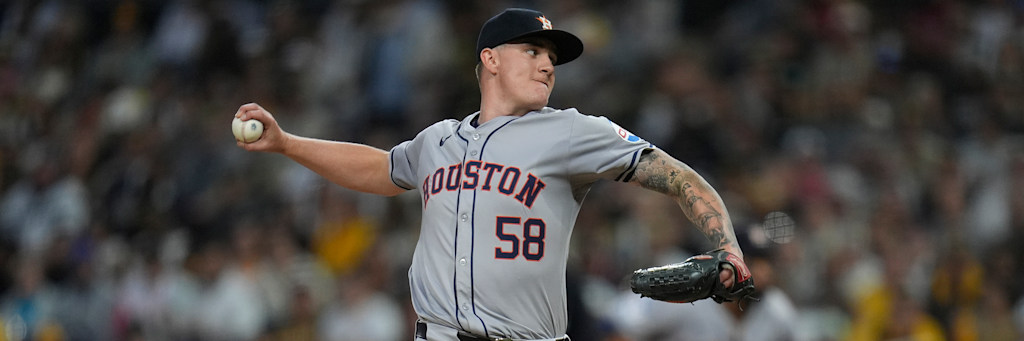
Hunter Brown is the second concern. He is 3-3 with a 3.67 earned run average, and his strikeout rate is genuinely excellent at 9.44 per nine. His walk rate is not. Forty walks in 68.2 innings is 5.24 per nine, the worst mark among the eight starters going tonight, and 13 starts covering 68.2 innings means he averages 5.28 innings per outing. A two run margin will therefore be defended for three or four innings by a Houston bullpen attached to a staff that has allowed 629 runs, more than the Astros have scored.
On the Cleveland leg, the honest read is that the run environment swallows favorites. Colorado scores 4.78 runs per game, the highest average of any team on this card, and a starter allowing 1.50 home runs per nine at that elevation is a specific and unpleasant combination.
And on Detroit, Drew Anderson is a swingman rather than a rotation regular, with only five starts inside 76.1 innings of work. That has no direct bearing on the Tigers team total, but it does mean this game may go long and stay open, and long games are where a team total under gets beaten in the eighth.
WHERE I COME DOWN
The alternate -1 is the correct instrument for this game, and that is the argument I will defend hardest tonight. Houston has produced two run separation in 52 of its 65 wins, and the season series against the Athletics has never once finished inside two runs. Paying 60 cents off the moneyline to convert the one losing shape that hurts most into a refund is a sound trade, even at a 64.29 percent break even.
The leg I would size down if I were building this card myself is Detroit. A 1.5 unit stake at -139 on a team total whose season base rate is 56.2 percent asks the head to head record and one starter to carry the whole difference. It may well land. It is still the thinnest edge of the four.
QUESTIONS ON THIS CARD
Why take Houston at -1 instead of the standard -1.5?
The alternate -1 turns a one run Houston win from a loss into a push. Houston has won 52 games by two or more and only 13 by exactly one, and the seven Astros versus Athletics games this season have all finished by two runs or more. The refund is worth the 60 cents it costs against the -240 moneyline.
Which leg is the weakest?
Detroit team total under 4.5 at -139, carrying 1.5 units. The Tigers have scored four or fewer in 72 of 128 games, 56.2 percent, against a 58.16 percent break even. The case leans on Michael Wacha and on Detroit going under this number in nine of 11 meetings with Kansas City.
What does the card require overall?
Weighted by stake, 59.89 percent. The individual break evens are 55.75 percent at -126, 64.29 percent at -180, 58.16 percent at -139 and 57.81 percent at -137.